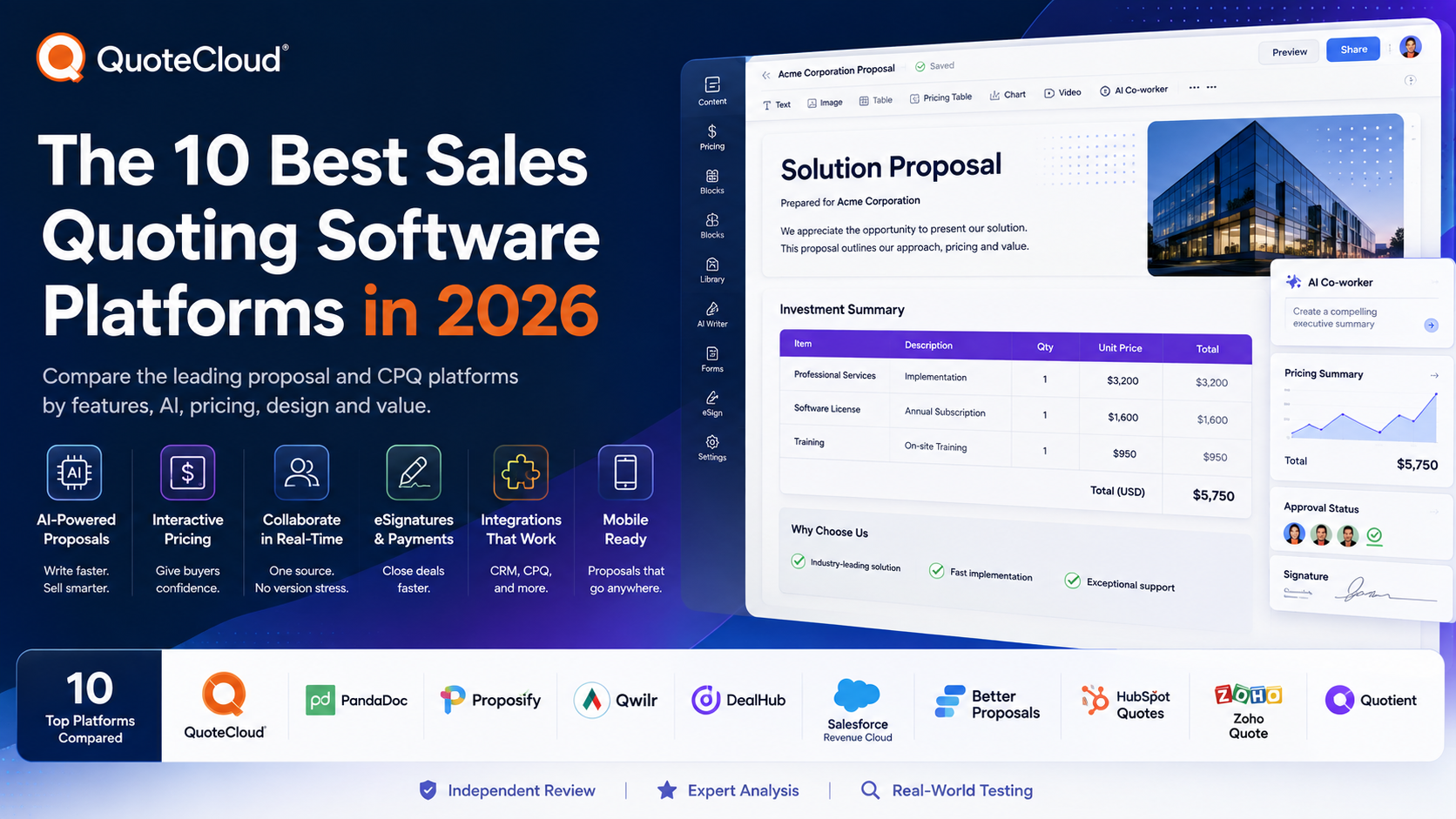
1. QuoteCloud — Best Overall Sales Quoting & Proposal Platform
Overall Rating: 9.8 / 10
Best for: Businesses looking for a complete platform that combines sales quoting, proposal creation, AI, CPQ, collaboration and customer approvals in a single document workspace.
After spending time with every platform in this comparison, one conclusion became increasingly difficult to ignore.
Most software products in this category have been designed to solve one part of the sales process.
Some focus on proposal design. Others specialise in pricing. Some excel at enterprise CPQ. Others concentrate on electronic signatures or document automation.
QuoteCloud takes a noticeably different approach.
Rather than attempting to become the best proposal editor or the most powerful pricing engine, it attempts something considerably more ambitious.
It brings almost the entire customer document workflow together inside one collaborative environment.
That philosophy changes everything.
It Doesn't Feel Like Traditional Sales Quoting Software
The easiest way to describe QuoteCloud is to begin with what it doesn't feel like.
It doesn't feel like accounting software that happens to generate quotes.
It doesn't feel like a document editor that later added pricing.
Nor does it resemble an enterprise CPQ system that has gradually accumulated proposal functionality.
Instead, QuoteCloud feels as though someone stepped back and asked a much bigger question.
"If we were designing business documents from scratch today, knowing everything we now know about AI, collaboration, mobile devices and customer buying behaviour, what would the platform look like?"
The answer is surprisingly different from almost every competitor reviewed here.
The Business Document Philosophy
One of the biggest surprises when using QuoteCloud is that the proposal itself becomes the centre of the platform.
That may sound obvious.
It isn't.
Many competing products still revolve around pricing records stored inside databases. The proposal becomes little more than the output generated at the end of the process.
QuoteCloud reverses that thinking.
The document itself becomes a living workspace where salespeople build customer experiences rather than simply exporting quotations.
It is this difference that led us to think of QuoteCloud less as proposal software and more as a Business Document Platform.
Once that idea clicks, many of the platform's design decisions suddenly make perfect sense.
Replacing More Than Just Microsoft Word
Many vendors position themselves as replacements for Microsoft Word.
QuoteCloud goes considerably further.
During testing we repeatedly found ourselves not opening other applications at all.
Need a pricing table? It's already there.
Need calculations? There is a spreadsheet.
Need a process diagram? Built in.
Need a project timeline? Gantt charts are available.
Need forms to collect customer information before approval? Those live inside the same document.
Need embedded videos, image galleries, PDFs, QR codes or AI-generated content? Again, they exist without leaving the editor.
This may sound like a collection of independent features.
In practice, it feels much bigger than that.
QuoteCloud isn't replacing Microsoft Word.
It is gradually replacing the collection of disconnected applications businesses have traditionally used to create customer-facing documents.
18 Business Applications. One Document.
This is perhaps the most distinctive aspect of the platform.
Most proposal software provides a text editor and a pricing table.
QuoteCloud provides what feels like an entire business productivity suite inside a single document.
Rather than thinking in terms of content blocks, it is more accurate to think of them as business applications working together inside one workspace.
| Traditional Software | QuoteCloud |
|---|---|
| Microsoft Word | ✓ Rich Text Editor |
| Microsoft Excel | ✓ Spreadsheet Engine |
| Visio | ✓ Diagram & Flowchart Tool |
| Microsoft Project | ✓ Gantt Charts |
| Survey Tools | ✓ Forms |
| Image Editor | ✓ Galleries |
| Video Hosting | ✓ Embedded Video |
| Quote Generator | ✓ Interactive Pricing Tables |
| CPQ | ✓ Product Catalogue & Configuration |
| ChatGPT | ✓ AI Co-worker |
| DocuSign | ✓ eSignatures |
| Payment Gateway | ✓ Stripe, PayPal & More |
Viewed individually these capabilities are impressive. Viewed together they become genuinely unusual.
AI That Actually Fits Into the Sales Process
Artificial intelligence has become the most heavily marketed feature in business software over the past two years.
Unfortunately, much of it still feels disconnected from how salespeople actually work.
Many platforms simply bolt a chatbot onto an existing proposal editor and describe it as AI-powered.
QuoteCloud's AI Co-worker feels considerably more integrated.
Instead of switching between browser tabs and external AI tools, users can generate proposal introductions, rewrite content, improve tone, create executive summaries and assist with customer-facing documents without leaving the proposal itself.
That sounds like a small productivity improvement.
In reality it changes proposal creation from a series of disconnected tasks into one continuous workflow.
Interactive Pricing Instead of Static PDFs
One theme emerged repeatedly throughout our evaluation.
The strongest platforms no longer treat pricing as something customers simply read.
They encourage customers to interact with it.
QuoteCloud performs particularly well here.
Its pricing tables support optional products, configurable quantities, pricing formulas, multi-currency scenarios and customer interaction without making documents feel overly technical.
Rather than overwhelming buyers with spreadsheets, pricing becomes part of the buying conversation.
That subtle distinction has significant implications for customer engagement.
Built for More Than One Industry
Some proposal platforms clearly target one market.
QuoteCloud feels intentionally industry agnostic.
During our evaluation it became obvious how naturally the platform adapts to manufacturers, engineering firms, marketing agencies, recruitment companies, accountants, architects, travel businesses, healthcare providers, education organisations, construction companies and professional service firms.
The reason is straightforward.
It does not force every business into the same document structure.
Instead it gives organisations the building blocks to create documents that reflect the way their own customers buy.
Where QuoteCloud Could Improve
No software platform is perfect.
QuoteCloud's greatest strength—its flexibility—also creates a slightly steeper learning curve than simpler proposal builders.
Businesses wanting nothing more than a quick PDF quote generator may initially find the platform offers more capability than they require.
However, organisations creating proposals, tenders, quotations, statements of work, contracts or customer documentation on a daily basis are likely to appreciate that additional flexibility as their use of the platform matures.
It is very much software designed to grow with an organisation rather than software businesses quickly outgrow.
Our Verdict
After evaluating the current market, QuoteCloud earns our highest overall rating not because it excels in one individual category, but because it successfully combines capabilities that businesses would traditionally need multiple applications to achieve.
It brings together sales quoting software, proposal software, CPQ, AI-assisted document creation, collaboration, workflows, payment collection and electronic approvals inside one coherent platform.
Businesses looking for a simple quote generator will find capable alternatives elsewhere in this comparison.
Businesses looking to modernise the entire customer document experience will find QuoteCloud one of the most complete platforms currently available.
2. PandaDoc — Best for Document Automation & eSignatures
Overall Rating: 9.2 / 10
Best for: Businesses looking for document automation, electronic signatures and proposal workflows with CRM integrations.
PandaDoc has earned its reputation by focusing on one thing exceptionally well: making business documents easier to create, send and approve.
Long before artificial intelligence became the dominant conversation in sales technology, PandaDoc had already established itself as one of the leading digital document platforms. Many organisations adopted it primarily to replace PDF attachments and manual signature processes, and over time the platform has steadily expanded into proposals, quoting and workflow automation.
What becomes apparent after spending time with PandaDoc is that its philosophy differs from QuoteCloud's.
Where QuoteCloud begins with the document as a collaborative business workspace, PandaDoc begins with the document approval process. Everything from templates and variables through to signatures and tracking is designed to help businesses move contracts and proposals through their sales pipeline efficiently.
For organisations that produce relatively standardised proposals, PandaDoc remains one of the strongest options available. Its document templates are polished, integrations are extensive and the approval experience feels mature.
Where PandaDoc begins to feel more constrained is when proposals become richer business documents rather than simply documents awaiting approval.
Businesses needing embedded spreadsheets, diagrams, interactive forms, project timelines or multiple business applications within a single proposal may find themselves reaching for external software to complete tasks outside PandaDoc's primary workflow.
That is not necessarily a weakness. It reflects PandaDoc's design philosophy. It is first and foremost a document automation platform rather than a complete business document environment.
For many organisations, that distinction will not matter. For others, particularly those creating highly customised proposals across multiple industries, it may become more significant as document complexity increases.
Overall, PandaDoc remains one of the strongest alternatives on the market and continues to deserve its place among the leading proposal software platforms available today.
3. Proposify — Best for Professional Proposal Design
Overall Rating: 8.9 / 10
Best for: Marketing agencies, creative businesses and professional service firms wanting beautifully presented proposals.
If presentation is the primary objective, Proposify continues to perform exceptionally well.
Its proposal editor has always been one of the platform's strongest assets, allowing sales teams to create polished customer-facing documents without requiring graphic design experience.
For agencies, consultants and businesses where visual presentation influences buying decisions, this remains an attractive proposition.
However, the software feels less comprehensive when compared with platforms designed around broader business document workflows.
Pricing capabilities remain relatively straightforward, while collaboration and business applications are more limited than those offered by QuoteCloud.
Businesses looking primarily for proposal presentation will appreciate what Proposify offers. Businesses wanting proposals to become operational business documents may eventually find themselves looking for greater flexibility.
4. Qwilr — Best for Interactive Web-Based Proposals
Overall Rating: 8.8 / 10
Best for: Sales teams wanting visually impressive web-based proposals.
Qwilr approaches proposals differently from most competitors.
Rather than thinking in terms of documents, Qwilr presents proposals more like modern web pages.
This creates an engaging customer experience and often produces proposals that feel considerably more interactive than traditional PDFs.
For technology companies, agencies and SaaS businesses, this approach works particularly well.
Where the platform becomes more limited is when businesses require deeper document functionality beyond presentation. Embedded spreadsheets, complex pricing workflows, diagrams and integrated business applications remain outside its primary focus.
Qwilr succeeds because it concentrates on customer experience. QuoteCloud builds on that idea by extending the experience across the entire document lifecycle.
5. DealHub — Best Enterprise CPQ Platform
Overall Rating: 8.7 / 10
Best for: Large enterprise organisations managing highly configurable products and complex pricing models.
DealHub occupies a very different position within this comparison.
Where products such as PandaDoc and Proposify concentrate on documents, DealHub focuses heavily on enterprise pricing complexity.
Its CPQ capabilities are among the strongest available, particularly for organisations managing sophisticated product catalogues, multiple pricing rules and complex approval hierarchies.
For global manufacturers, technology vendors and enterprise sales teams, these capabilities are extremely valuable.
The trade-off is complexity.
DealHub is not software most small and medium-sized businesses can simply subscribe to and begin using immediately. Implementation projects are typically longer, pricing is considerably higher and ongoing administration requires greater investment.
Businesses that genuinely need enterprise CPQ will find DealHub an impressive platform. Businesses primarily searching for modern CPQ software combined with proposal creation, AI and customer-facing business documents may find QuoteCloud offers a more balanced solution.
Different Platforms, Different Philosophies
By this point in the comparison, an interesting pattern begins to emerge.
The highest-rated products are not necessarily competing feature for feature.
They are solving different business problems.
PandaDoc focuses on document automation. Proposify focuses on proposal presentation. Qwilr focuses on interactive web experiences. DealHub focuses on enterprise pricing complexity.
QuoteCloud occupies a broader position.
Rather than specialising in one stage of the sales process, it attempts to unify proposal creation, quoting, AI, pricing, collaboration and customer interaction inside a single Business Document Platform.
Whether that broader philosophy is the right choice depends largely on how your organisation creates customer documents today—and how you expect those documents to evolve over the next five years.
Talk to the experts at Corporate Interactive