Proposal vs Quote vs Estimate: What's the Difference?
A customer asks how much a project is likely to cost.
Should you send an estimate?
They provide more detailed requirements and ask for a price.
Is that now a quote?
Then they ask you to explain how you would approach the work, what is included and why they should choose your business.
Now you are probably preparing a proposal.
The terms estimate, quote and proposal are frequently used interchangeably in sales. In some businesses, the same document may even be called different things by different people.
But they serve different commercial purposes.
The easiest way to understand the distinction is not by looking at the document format.
It is by looking at the question the customer is trying to answer.
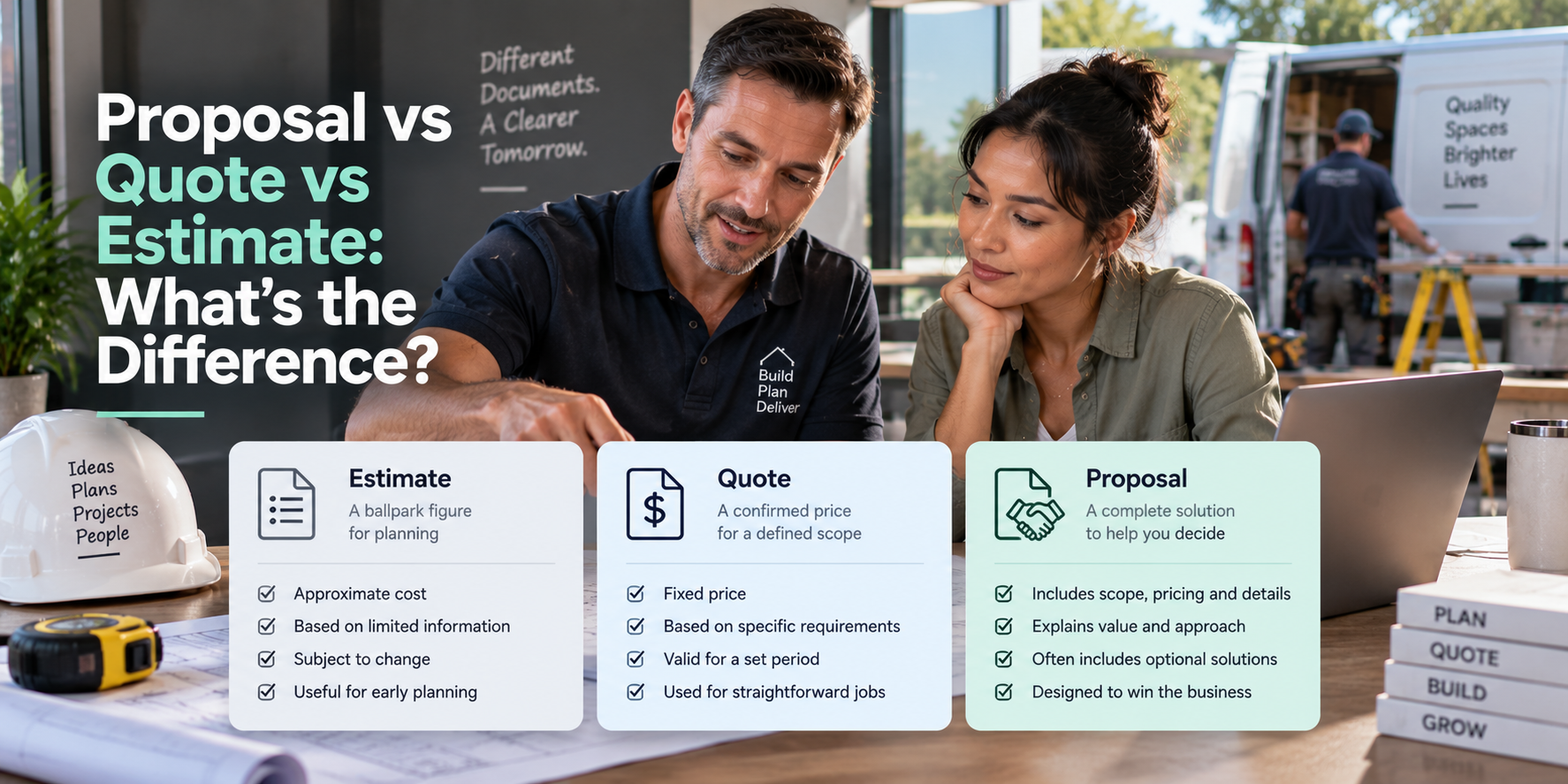
An estimate helps answer, “Roughly what might this cost?” A quote answers, “What will you charge me for this defined requirement?” A proposal answers the broader question, “What do you recommend, why should we choose it, what will it cost and what happens next?”
Understanding those differences helps businesses provide the right amount of information at the right stage of a sale.
An Estimate Helps a Customer Understand the Likely Cost
An estimate is generally most useful when there is not yet enough information to provide a definitive price.
Imagine a homeowner contacting a landscaping company and saying they want to redesign their backyard.
They may not yet have detailed plans. Materials have not been selected. The amount of excavation is unknown. They have not decided whether they want lighting, irrigation or a new entertaining area.
But they still need to know whether the project is likely to cost $10,000, $30,000 or $100,000.
An estimate can help establish that.
It gives the customer a reasonable indication of likely cost based on the information currently available.
The same principle applies in B2B sales.
A company considering a new technology project may need an indicative budget before management will approve a detailed discovery process. An engineering firm may provide an early cost range before specifications have been completed. A marketing agency may indicate the likely investment before campaign requirements are fully defined.
The important characteristic is uncertainty.
An estimate acknowledges that some of the variables required to determine the final price are not yet known.
A Good Estimate Makes Its Assumptions Clear
The danger with estimates is that customers can remember the number and forget the uncertainty.
Tell someone that a project will “probably be around $20,000” and there is a good chance that $20,000 becomes the figure against which every future conversation is judged.
That makes assumptions important.
If an estimate is based on limited information, say so.
If certain costs have not yet been included, identify them.
If the final price will depend on site inspection, quantities, specifications or another discovery process, explain that clearly.
An estimate should give customers useful information without creating false certainty.
A Quote Is Appropriate When the Requirement Becomes Defined
A quote usually comes later.
The customer has provided enough information for the supplier to determine what is being sold and what it will cost.
The landscaper now has measurements, plans and material selections.
The electrician knows which equipment needs to be installed.
The telecommunications provider knows the number of users, services and locations.
The equipment supplier knows the required models, quantities and configuration.
At this point, the seller can produce a much more specific commercial offer.
A typical sales quote identifies the products or services being supplied, quantities where relevant, individual or total prices, taxes, commercial terms and the period for which the pricing remains valid.
For many straightforward transactions, that is all the customer needs.
If a buyer already knows exactly what they want and is simply asking what you will charge to supply it, forcing them to read a 20-page proposal may actually make the buying experience worse.
This is where efficient sales quoting software becomes particularly useful: creating accurate, consistent and professionally presented commercial offers without turning every sale into a major document-production exercise.
A Quote Is More Than a Price Written in an Email
It can be tempting to respond to a straightforward enquiry with nothing more than a number.
“We can do that for $7,500.”
But even relatively simple sales benefit from clarity.
What exactly is included in the $7,500?
Does it include delivery?
Installation?
Taxes?
How long is the price valid?
When can the work be completed?
What payment terms apply?
A properly structured quote reduces the possibility that the customer and seller are agreeing to two different interpretations of the same conversation.
A Proposal Has a Different Job
A proposal becomes useful when the customer is not simply buying a defined product at a known price.
They are evaluating an approach.
This commonly occurs in professional services, technology, telecommunications, construction, marketing, engineering and other solution-based sales.
It can also occur in B2C sales.
A family considering a major renovation may receive several very different approaches from builders. A customer planning a complex holiday may want more than a list of flights and hotels. Someone considering a substantial solar and battery installation may need to understand system design, expected outcomes, equipment choices and warranties.
In these situations, price is important—but it is only part of the decision.
A sales proposal can explain the customer's requirements, recommended solution, scope, methodology, supporting evidence, pricing, implementation and next steps within a single commercial story.
The objective is not simply to tell the customer what something costs.
It is to help them decide whether the proposed solution is the right one.
The Difference Becomes Clear When You Look at the Buyer's Question
Consider a business looking to replace the security system across several facilities.
Early in the process, management might ask:
“Can you give us an idea of what a project like this is likely to cost?”
An estimate may be appropriate.
Later, after a site assessment, the customer might ask:
“What would you charge to install these cameras, access-control points and monitoring equipment?”
Now a quote may be appropriate.
But if several suppliers are competing and the customer asks:
“How do you recommend we improve security across these sites?”
That requires something more.
The supplier may need to explain its assessment of the current environment, recommended architecture, equipment choices, implementation plan, support model and commercial offer.
That is proposal territory.
A Proposal Can Contain a Quote
This is where the terminology sometimes becomes confusing.
A proposal and a quote are not necessarily competing document types.
A proposal can contain a quotation.
The proposal provides the broader commercial narrative while the quote provides the pricing detail.
For example, a proposal might begin by describing the customer's current situation and objectives. It then presents the recommended solution, explains implementation and provides supporting evidence.
Later in the document, a pricing table sets out exactly what the solution will cost.
That section effectively performs the role of the quote within the larger proposal.
This is why modern digital sales documents can be useful. Businesses do not necessarily need separate disconnected files for every part of the buying process.
Using interactive business document content, narrative, pricing tables, images, diagrams, optional selections, spreadsheets and supporting material can coexist within the same customer-facing document where appropriate.
The More Complex the Decision, the More Valuable the Proposal Becomes
Simple purchasing decisions generally require less explanation.
If a customer needs 100 units of a clearly specified product and suppliers are offering essentially equivalent items, price, availability and terms may dominate the decision.
A quote is likely to be enough.
But complexity changes the role of the sales document.
When the buyer has multiple options, competing approaches, configurable products or significant implementation risk, they need more help evaluating the decision.
This is particularly true where several stakeholders are involved.
A technical team may care about specifications. Finance cares about cost. Operations cares about disruption. Management cares about the business outcome.
A proposal provides room to address those perspectives.
Where Does CPQ Fit?
Some businesses have a different problem.
They know what type of document they need, but determining what can actually be sold and at what price is complicated.
A telecommunications solution might contain compatible services, hardware and contract terms. Industrial equipment may have dependencies between options. Software packages may vary according to users, modules and implementation requirements.
In these situations, the challenge occurs before the quote or proposal is generated.
The seller needs to configure the appropriate solution and calculate valid pricing.
CPQ software—configure, price, quote—helps manage that process by connecting product configuration and pricing rules to the generation of the customer-facing commercial offer.
The resulting output may still be called a quote or proposal depending on how much explanation the sale requires.
Don't Use a Proposal When a Quote Will Do
Businesses sometimes assume that a bigger document creates a more professional impression.
Not necessarily.
If the customer knows exactly what they want, unnecessary information becomes friction.
Imagine asking a supplier for the price of replacing four tyres and receiving a 15-page proposal explaining the history of the company, its corporate values and philosophy of vehicle maintenance.
The document may look impressive.
It is also solving a problem the customer did not have.
Good sales communication is proportionate to the decision.
Sometimes the most professional response is a clear, accurate quote that the customer can understand in 30 seconds.
And Don't Use a Quote When the Customer Needs a Proposal
The opposite mistake can be considerably more expensive.
A seller spends hours understanding a customer's business and developing a thoughtful solution, then sends a spreadsheet containing product codes and prices.
The customer now has to reconstruct the value of the solution themselves.
Worse, competing suppliers may present their recommendations much more effectively.
The decision then becomes easier to reduce to price because the seller has failed to communicate the differences that justify its approach.
When the solution itself is part of what you are selling, explain it.
Document Generation Should Follow the Sales Process
One reason organisations blur estimates, quotes and proposals is that their document process is fragmented.
Estimates live in spreadsheets. Quotes are generated in accounting software. Proposals are copied from old Word documents. Customer information is retyped into each system.
That fragmentation creates duplicated work and inconsistent information.
Modern document generation software can help businesses use customer, product and pricing data across different document types while still producing the level of detail appropriate to each stage of the sale.
The objective is not to force every opportunity through exactly the same document.
It is to make producing the right document easier.
What About Acceptance and Signatures?
Any of these documents can eventually become part of a commercial agreement, depending on how the business operates and how the document is written.
A customer might accept a straightforward quote. A proposal may contain formal acceptance terms. In other circumstances, the proposal is followed by a separate contract.
This is also where terminology should not be mistaken for legal certainty.
Calling something an “estimate” does not automatically determine all of its legal consequences, just as calling a document a “proposal” does not necessarily mean it cannot create contractual obligations. The wording, circumstances and applicable law matter.
Businesses should obtain appropriate legal advice when designing contractual documents and acceptance processes.
Where digital acceptance is appropriate, electronic signature software can allow the customer to move from reviewing the commercial document to formally accepting it without reverting to printing and scanning paperwork.
Choose the Document That Matches the Decision
The distinction between an estimate, quote and proposal becomes much easier when you stop thinking about what your business calls the document and start thinking about what the customer needs from it.
If they need an approximate indication of likely cost while requirements are still developing, an estimate may be enough.
If they know what they want and need a clear price and terms, send a quote.
If they are evaluating a solution, an approach or competing suppliers, a proposal gives you the opportunity to explain why your recommendation makes sense as well as what it costs.
QuoteCloud allows businesses to create sales quotes, proposals and other customer-facing commercial documents using connected pricing, reusable content, interactive elements and electronic acceptance.
But choosing the right document starts before any software is opened.
The best sales document is not the one with the most pages. It is the one that answers the customer's next question clearly enough for them to move forward.
Sometimes that requires an estimate.
Sometimes a quote.
And sometimes it takes a proposal to tell the complete story.