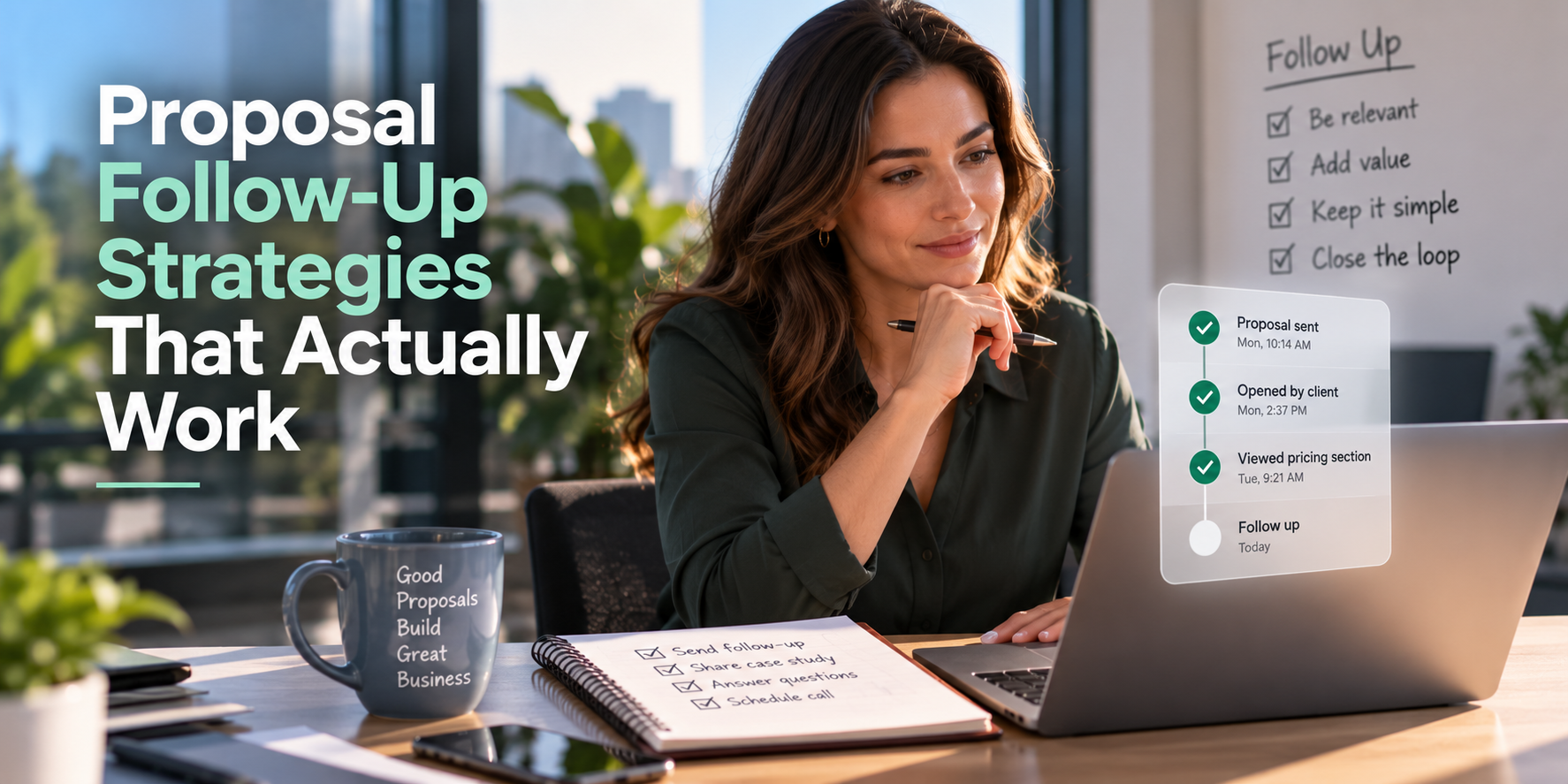
Proposal Follow-Up Strategies That Actually Work
There may be no sentence in B2B sales more familiar than this one:
“Just checking whether you've had a chance to look at my proposal.”
It appears in inboxes every day. Sometimes it receives a response. Frequently it doesn't.
The problem is not that following up is wrong. Quite the opposite. Once a proposal has been sent, thoughtful follow-up is often essential to keeping an opportunity moving.
The problem is that many follow-ups give the customer absolutely nothing new to respond to.
The salesperson wants an update, so they ask the customer for one. From the buyer's perspective, however, nothing has changed. They may still be discussing the proposal internally, waiting for approval, comparing alternatives or dealing with another priority entirely.
Another “just checking in” email does not help them make the decision.
Effective proposal follow-up works differently.
It does not simply ask where the customer is. It gives the customer a reason to take the next step.
Follow-Up Should Begin Before You Send the Proposal
One of the most effective proposal follow-up strategies happens before the proposal has even left your hands.
Agree on what happens next.
If the final conversation ends with, “I'll send you the proposal this afternoon,” the salesperson has created a delivery commitment but no next step.
A stronger conversation sounds more like this: “I'll send the proposal this afternoon. Why don't we schedule 20 minutes on Thursday to go through any questions after you've had a chance to review it?”
The difference is significant.
In the first scenario, the salesperson sends the document and then has to find a reason to contact the customer again.
In the second, the next conversation already exists.
This also changes the psychology of the follow-up. The salesperson is not chasing the buyer for an answer. Both parties are continuing a process they already agreed upon.
For significant B2B opportunities, that should be the preferred approach whenever practical.
Stop Treating Silence as a Single Message
When a customer does not respond to a proposal, salespeople naturally start interpreting the silence.
They aren't interested.
The price is too high.
They chose a competitor.
The project has been cancelled.
Any of those things could be true. But silence itself tells you remarkably little.
The buyer may simply be busy. Your contact may be waiting for their manager. Procurement may be reviewing the commercial terms. The proposal may have been forwarded to another department. The internal champion may be building a business case.
One of the purposes of good follow-up is to discover what is actually happening without forcing the customer into an artificial yes-or-no answer before they are ready.
That requires curiosity rather than pressure.
A Good Follow-Up Adds Something to the Conversation
Before sending a follow-up, ask a simple question:
What is different about this message from the last one?
If the only difference is that another three days have passed, the customer has little reason to engage.
A useful follow-up might clarify a question raised during the meeting. It might provide an implementation example, relevant case study, revised calculation or additional information requested by another stakeholder.
It might address an objection before the buyer has formally raised it.
Imagine a company considering a new telecommunications system. The original proposal covers the solution and pricing, but the salesperson later realises that migration risk was a significant concern during discovery.
A follow-up explaining the migration process, expected downtime and implementation support is considerably more useful than:
“Just wondering if you have any feedback on our proposal?”
The first message helps the buyer make progress.
The second asks the buyer to help the salesperson make progress.
Timing Matters More Than Frequency
There is no universal rule saying a salesperson should follow up exactly two days, three days or one week after sending a proposal.
The appropriate timing depends on the buying process.
A $2,000 service proposal for a small business is different from a six-figure technology implementation requiring finance, IT, procurement and executive approval.
Sales teams sometimes compensate for uncertainty by increasing frequency. If the customer has not replied, send another email. Then another. Then call. Then send a LinkedIn message.
Persistence has a place in sales, but frequency without relevance can quickly feel like pressure.
A better approach is to understand the customer's decision process before the proposal is sent.
Who needs to review it? When are they likely to discuss it? Is there a board meeting, budget cycle, tender deadline or project date influencing the decision?
The answers give follow-up timing commercial context.
This is also why the timing of B2B sales proposals matters in the first place. Proposal delivery and proposal follow-up should be treated as parts of the same buying journey rather than unrelated sales activities.
Follow the Buyer's Activity, Not Just Your CRM Reminder
Traditional proposal follow-up is largely based on elapsed time.
The proposal is sent on Monday. The CRM creates a task for Thursday. On Thursday, the salesperson follows up.
But elapsed time is only one signal.
Digital proposals can provide another: buyer behaviour.
Knowing that a customer has opened a proposal, returned to it or spent time reviewing particular sections can help salespeople make better-informed decisions about when to engage.
Consider the difference between two prospects who have both been silent for four days.
One has never opened the proposal.
The other has returned several times and is actively reviewing the commercial information.
Those situations may warrant very different follow-up conversations.
Modern proposal software can give sales teams greater visibility into what happens after a document has been delivered, reducing some of the guesswork that traditionally surrounds proposal follow-up.
The important point, however, is not to turn engagement data into surveillance.
A salesperson does not need to tell the customer, “I noticed you looked at page nine three times this morning.”
That is unlikely to improve the relationship.
Engagement information should inform the salesperson's judgement, not become the subject of the conversation.
Use the Follow-Up to Reduce Risk
Many B2B decisions stall because the buyer perceives risk.
Will implementation be difficult? Will employees adopt the solution? What happens if something goes wrong? Is the supplier financially stable? Can the project be delivered on time?
The salesperson may believe the proposal has answered these questions, but buyers often need reassurance as the decision becomes more real.
Follow-up is an opportunity to reduce that uncertainty.
A contractor might provide clarification around scheduling and site management. A software provider might explain onboarding and migration. An engineering firm might expand on project governance. A marketing agency might explain reporting and performance measurement.
These conversations matter because customers are rarely deciding purely between competing products.
They are deciding between competing levels of confidence.
Don't Automatically Reach for a Discount
Silence after a proposal can make salespeople nervous.
One common reaction is to change the commercial offer.
“If we can get this approved by Friday, I may be able to offer another 10%.”
There are circumstances where commercial negotiation is appropriate. But introducing a discount before the customer has objected to price can create a problem that did not previously exist.
It tells the buyer that the original price was negotiable.
Worse, it can shift attention away from value and towards the question of how much further the supplier might move.
Before changing price, understand the obstacle.
If pricing genuinely is the issue, there may be better alternatives than simply reducing it. Scope can change. Optional components can be removed. Contract terms can be adjusted. Different configurations can be considered.
For businesses dealing with configurable products or more complex pricing, CPQ software can help sales teams explore commercially valid alternatives without resorting to arbitrary discounting.
Make It Easy for Your Contact to Bring Other People Into the Decision
Proposal follow-up often reveals something the salesperson should ideally have discovered earlier: another person needs to be involved.
Rather than treating that as an obstacle, make it easier.
Ask whether it would be useful to walk the additional stakeholder through the proposal. Offer information specifically relevant to finance, technical teams, procurement or management.
Remember that your primary contact may be trying to explain the proposal internally without you.
The easier the proposal is to understand and share, the better equipped that person is to advocate for the project.
This is one reason interactive sales documents can be valuable. Instead of sending the buyer a collection of separate PDFs, spreadsheets, videos and supporting attachments, relevant material can be incorporated into a more coherent document experience using interactive business content.
A proposal that travels well through an organisation is easier to keep alive.
Ask Questions That Are Easy to Answer
“Do you have any feedback?” is a surprisingly demanding question.
It asks the customer to review the entire proposal, formulate an opinion and decide what information to provide.
Specific questions are easier.
“Does the implementation approach align with the timing you discussed?”
“Would it help if I separated the optional services from the core project?”
“Has your finance team had everything they need to review the commercial terms?”
Each question gives the customer a clear place to start.
Good follow-up reduces the effort required to respond.
Know When to Pick Up the Phone
Email is convenient, but not every sales conversation belongs in an inbox.
If a proposal is complex, if the customer has raised significant concerns or if several rounds of email are creating more confusion than clarity, a conversation is usually more productive.
Tone is easier to understand. Questions can be explored immediately. Misunderstandings that might take three days of email exchanges can sometimes be resolved in five minutes.
The purpose of the call should not be to corner the buyer into making a decision.
It should be to understand what remains unresolved.
When the Customer Is Ready, Remove the Final Friction
There is a point where follow-up has done its job.
The questions have been answered. The commercial terms are understood. The relevant stakeholders are comfortable. The customer is ready to proceed.
At that point, the process should become easier, not harder.
Requiring the customer to download a proposal, print an acceptance page, sign it, scan it and return it introduces unnecessary administration at precisely the moment when momentum should be converted into action.
Embedding electronic signatures into the proposal process allows customers to move directly from decision to acceptance.
Good follow-up creates momentum. Good process preserves it.
Sometimes the Best Follow-Up Is to Close the Loop
Not every proposal will convert.
There comes a point where repeated unanswered messages stop being follow-up and become noise.
A final message that respectfully acknowledges the lack of progress can often be more effective than another request for an update.
Tell the customer you understand that priorities may have changed. Let them know you will close the opportunity for now, while making it easy to restart the conversation if circumstances change.
This removes pressure and creates clarity for both sides.
Occasionally, it also generates the response the previous five follow-ups failed to produce.
But even when it doesn't, there is value in knowing when to redirect sales effort towards opportunities that are actually moving.
Follow-Up Should Help the Buyer, Not Chase the Buyer
The difference between effective persistence and irritating persistence is rarely the number of messages alone.
It is whether those messages continue to contribute something useful.
A good proposal follow-up answers a question, reduces risk, introduces relevant information, involves another stakeholder, clarifies a commercial issue or makes the next step easier.
Technology can help. QuoteCloud connects sales quoting, proposals, interactive content, buyer engagement and electronic acceptance within the sales document process, giving teams more information with which to manage opportunities after a proposal has been sent.
But no technology can replace judgement.
The salesperson still has to decide when to contact the customer, what to say and whether the conversation is genuinely moving forward.
The best guiding principle is remarkably simple:
Don't follow up because your sales process says it is time to contact the customer. Follow up because you have a reason that matters to the customer.
That is the difference between chasing a proposal and advancing a sale.