Free Sales Proposal Templates
Starting a sales proposal from a blank page is rarely a good use of anyone's time. Most businesses are not trying to invent an entirely new type of document every time they respond to a customer. They need a professional structure that already understands the basics: introduce the opportunity clearly, explain the proposed solution, present the commercial information, answer the questions a buyer is likely to have and make the next step obvious.
This is why sales proposal templates remain so useful even as document software becomes more sophisticated. A good template does not write the proposal for you, and it should never turn every customer document into an identical piece of generic marketing. What it does is remove the repetitive decisions that do not need to be made again every time a salesperson creates a document.
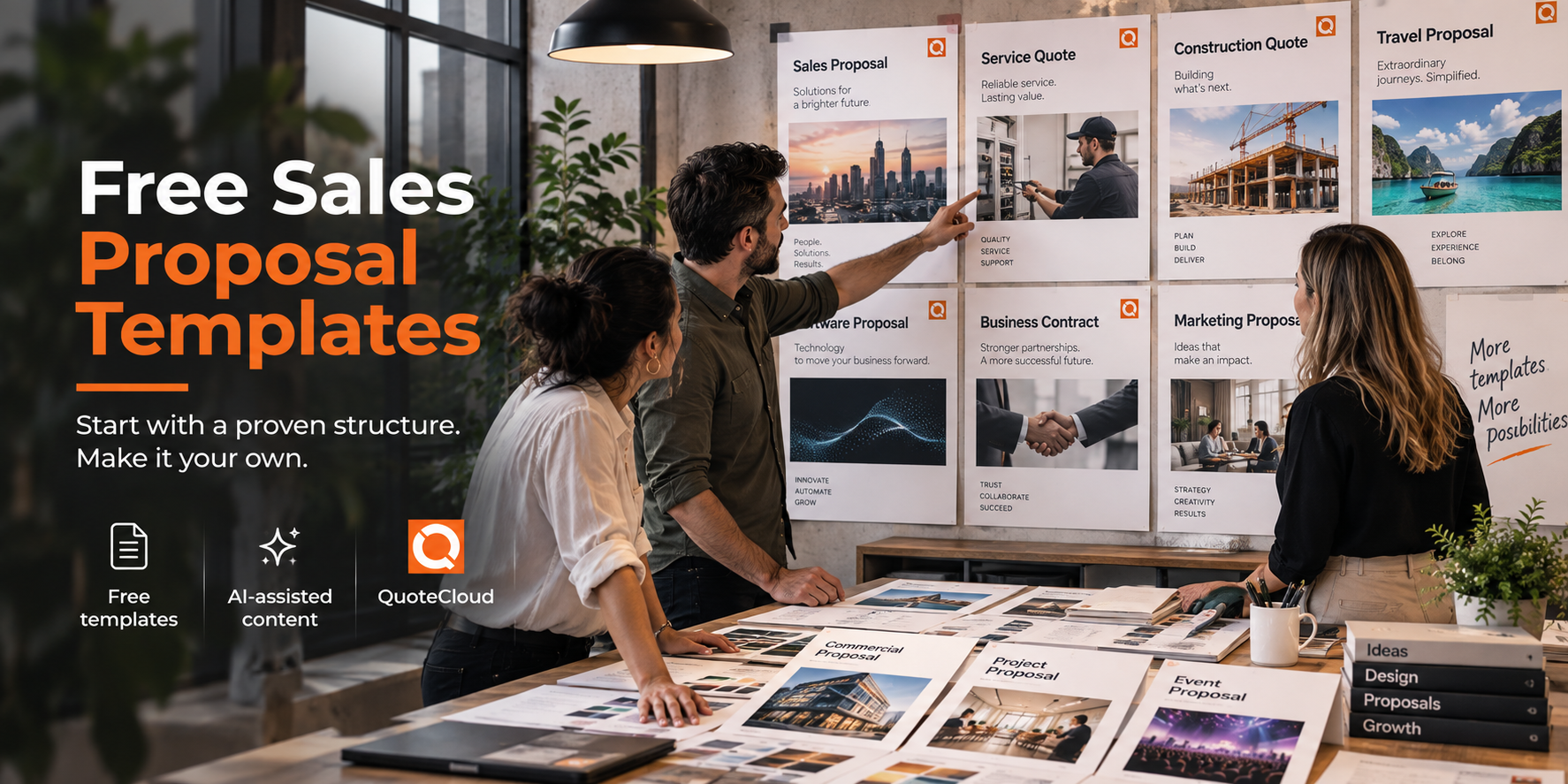
The QuoteCloud free document template library is built around that idea. Rather than providing only a handful of generic proposal designs, the library includes templates for many different industries and document types, including sales proposals, sales quotes, travel itineraries, construction documents, technology proposals, service quotations and specialised document components such as cover pages and pricing-table designs.
The best way to use a free proposal template is not to treat it as a finished document. Treat it as a professionally designed starting point that you can adapt to your business, your sales process and the customer in front of you.
A Good Template Solves the Structure Problem Before You Start Writing
One of the hardest parts of proposal creation is often not the writing itself. It is deciding what belongs in the document and in what order. Salespeople can spend unnecessary time debating whether the pricing should appear earlier, whether the company introduction is too long, how much detail to include about implementation or how to finish the document with a meaningful next step.
A well-designed template gives the salesperson a framework before that work begins. It might establish space for the customer's objectives, the recommended solution, pricing, key inclusions, terms and formal acceptance. An industry-specific template can go further by reflecting the information that buyers in that market are likely to expect.
A solar installer, for example, may need to explain system design, estimated benefits, equipment and installation. A travel company needs itinerary information, traveller details and booking conditions. An IT services business may need scope, technical recommendations and ongoing support. A construction proposal might require project inclusions, exclusions and commercial terms.
These are very different documents, which is why one universal sales proposal template is rarely enough. The value of a larger template library is the ability to begin with something that already resembles the commercial conversation you are trying to have.
For businesses using proposal software, that starting structure can then become far more flexible than a traditional Word or PDF template. The salesperson can retain the parts that are relevant, replace the content that is not and progressively develop the document into something that reflects the company's own sales method.
The Best Template Eventually Becomes Your Template
There is a natural temptation when downloading a free sales proposal template to change the logo, update the colours and consider the job finished. That produces a branded document, but it does not necessarily produce a document that represents the way your business sells.
The stronger approach is to look at the template as a model and then deliberately decide which parts should become standard across your organisation. Your business may have a particularly effective way of describing implementation. There may be a set of customer questions that should always be addressed. Perhaps pricing needs to distinguish recurring and one-off charges, or your sales model benefits from offering optional services rather than presenting one fixed total.
Over time, these decisions create a proposal framework that belongs to the business rather than to the original template designer.
This is particularly useful where multiple employees create customer-facing documents. Without a shared template structure, every salesperson can gradually develop their own version of the company story, product descriptions, commercial wording and pricing presentation. The differences may seem small individually, but collectively they can create inconsistency in how the company presents itself.
Using a centralised template inside QuoteCloud means the business can establish a strong starting document while still giving the salesperson room to personalise the parts of the proposal that should be unique to the customer.
Templates Are Just as Valuable for Quotes and Estimates
The word “template” is often associated with long-form proposals, but shorter commercial documents benefit from the same thinking. A quote may only need a page or two, yet consistency in pricing presentation, terms, optional products and acceptance can have a major effect on how professional the business appears.
A good quote template helps salespeople present information in a predictable way without rebuilding the layout every time. Businesses using quoting software can take this further by connecting the document structure to pricing information, customer data and repeatable commercial rules rather than treating the template as a static page.
The same principle applies to businesses searching for estimating software. Estimates often begin earlier in the customer journey, when every detail is not yet known, but they still need a clear structure. Assumptions should be obvious, allowances should be understandable and the customer should be able to distinguish an indicative figure from a final quotation.
This is why templates can play an important role across the whole sales-document process. One organisation may have an estimate template for early-stage opportunities, a quote template for defined requirements, and a more detailed proposal template for complex or higher-value opportunities. Each document serves a different purpose, but they can still share the same brand, content library and commercial logic.
AI Changes How Quickly a Template Can Become Relevant to Your Business
The emergence of AI makes starting from a template even more useful because the salesperson no longer needs to manually rewrite every section before the document feels specific to their business. AI can help transform a generic starting structure into a much more relevant first draft.
For example, a company could select an appropriate QuoteCloud template and use AI to rewrite the introduction around its particular industry and services. The same approach can be used to create sector-specific service descriptions, develop clearer explanations of technical products, turn rough notes into professional scope wording or create a first draft of frequently reused sections such as implementation, support and customer onboarding.
AI can also help when building the template itself. Instead of asking an employee to stare at a blank document and decide which sections a proposal should contain, the business can describe its sales process and ask AI to suggest a document structure. A web development company might ask for a proposal framework covering discovery, design, development, testing, hosting and support. An electrical contractor might ask for a structure covering scope, equipment, labour, exclusions, safety requirements and project assumptions.
The result should still be reviewed by someone who understands the business, but the time required to reach a useful first version can be dramatically reduced.
This is where AI works particularly well alongside templates. The template provides the controlled structure and visual framework, while AI helps generate or refine the content that fills it.
AI Can Help Build a Reusable Content Library, Not Just One Proposal
One of the more useful applications of AI is creating reusable sales content rather than generating a complete proposal from scratch every time. Most businesses have recurring sections that appear across many documents: company overview, product descriptions, service methodology, implementation process, support options, customer outcomes, case-study summaries and answers to frequently asked questions.
AI can help an organisation turn existing material into a cleaner, more consistent content library. Old proposals, website content, product documentation and internal notes can provide the source material, while AI can help rewrite that information into shorter or longer versions suitable for different documents.
A technology company might create separate approved descriptions for managed services, cybersecurity, cloud migration and consulting. A construction company might develop standard content explaining project management, site safety and handover. A marketing agency could create reusable sections for strategy, creative services, campaign management and reporting.
Once those sections have been reviewed for accuracy, they can be placed into QuoteCloud as reusable content rather than being regenerated or copied from an old proposal every time. This is an important distinction. AI should help the organisation develop better source material; it does not necessarily need to reinvent the company's message on every deal.
That combination gives salespeople both speed and control. They can begin with a strong template, use approved reusable material where consistency matters, and then use AI to personalise the sections that genuinely need to respond to the customer.
AI Is Particularly Useful When You Want to Build Templates for Different Industries
Businesses that sell into several markets often struggle with one generic proposal because the language that resonates in one sector may feel irrelevant in another. The underlying product may be the same, but the customer priorities can be completely different.
AI makes it much easier to create variations of a master template for particular industries. A software provider might keep the same commercial and implementation structure while creating versions tailored to professional services, construction, telecommunications and healthcare. A wholesaler may create different proposal versions for contractors, corporate procurement teams and resellers.
The important point is to preserve the parts of the document that should remain controlled while allowing the customer-facing narrative to become more specific.
The QuoteCloud template library already demonstrates how differently documents can be presented across sectors, with categories covering areas such as construction, consulting, technology, telecommunications, manufacturing, ecommerce, travel and trade services. Businesses can use those examples for inspiration even when they ultimately decide to build their own customised master templates.
Templates can also be useful at a much smaller level. The library contains individual cover-page and pricing-table designs, which means a business does not necessarily need to replace an entire proposal to improve how it looks. Sometimes upgrading one important section can make an existing document considerably more effective.
The Template Should Save Time Without Making the Proposal Feel Templated
There is one danger with every proposal template: the customer should not feel as though they have received one.
Templates are valuable behind the scenes because they remove repetitive production work. They become less valuable when they encourage salespeople to send the same generic story to every buyer. The fact that the business has made document creation easier should not be obvious to the customer.
A good proposal should still reflect the customer's objectives, terminology and priorities. The pricing should relate to the actual solution being recommended. The examples should feel relevant. The opening pages should make it clear that the salesperson understood the conversation that led to the proposal.
AI can help here as well, but the salesperson remains important. AI can rewrite a section around customer information, but someone still needs to decide whether the resulting proposal genuinely reflects the opportunity. Automation should remove production work rather than remove commercial judgement.
The best process therefore combines three things: a professional template, a controlled library of reusable content and intelligent personalisation where the opportunity requires it.
That is a much stronger use of free sales proposal templates than simply downloading a document and replacing the logo.
The template gives you the starting structure. AI can help you build and refine the content. QuoteCloud provides the environment where those elements can become a repeatable sales-document process rather than a collection of disconnected files.
For businesses looking to improve their proposals, quotations or estimates, the easiest place to begin is often not with a blank page. Browse the free QuoteCloud document template library, find a structure that is close to the way your business sells, and then make it progressively more specific to your own customers, processes and commercial model.
The objective is not to find the perfect template.
It is to find the right starting point and turn it into one.