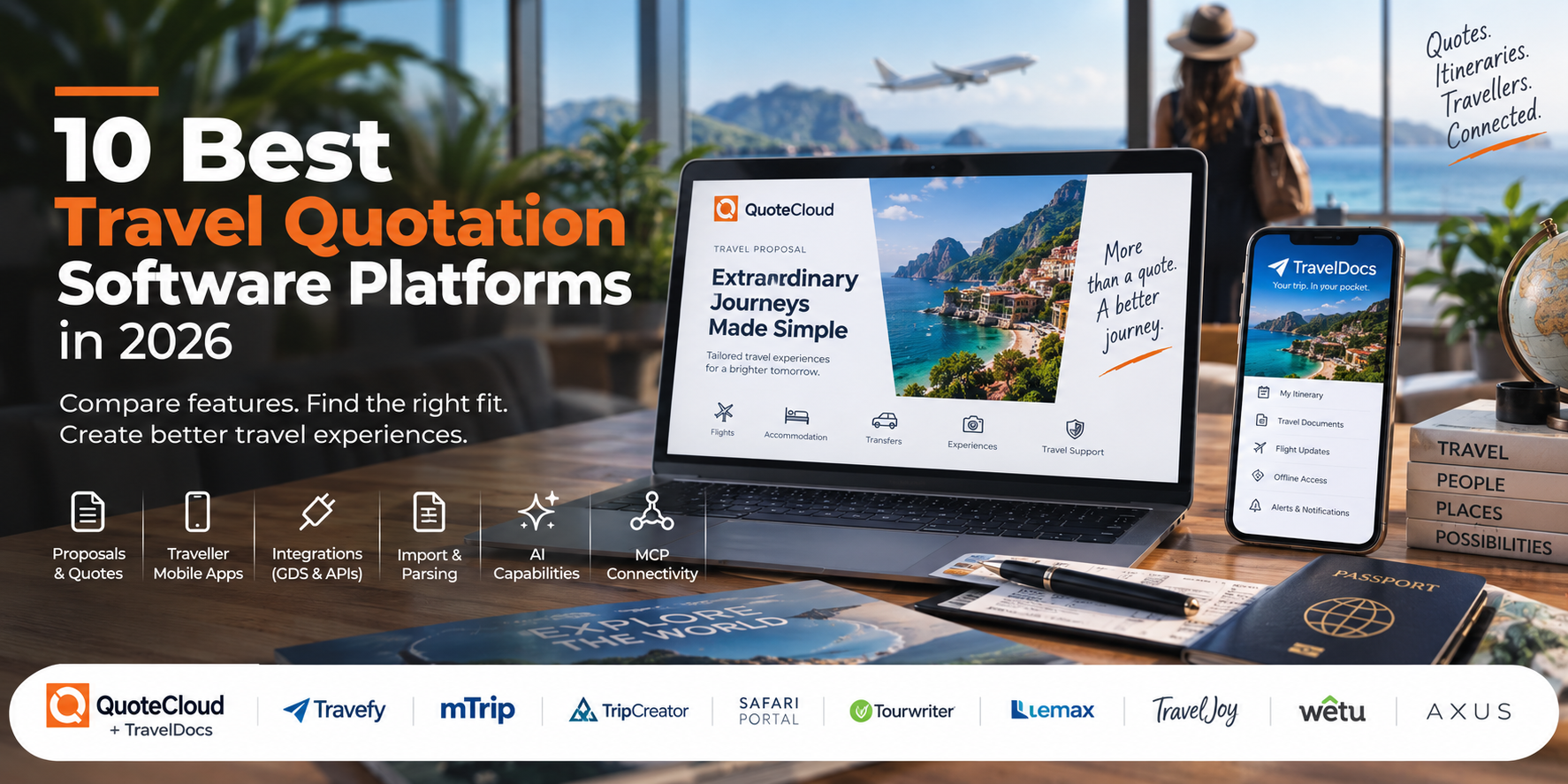
10 Best Travel Quotation Software Platforms in 2026
Choosing travel quotation software has become more complicated than it was even a few years ago. Travel companies are no longer simply looking for software that can put flights, hotels and a price into a PDF. The strongest platforms now sit much closer to the centre of the customer journey, connecting booking information, proposals, pricing, itinerary creation, traveller mobile apps, supplier content and increasingly artificial intelligence.
This also makes comparison difficult because the products come from different directions. Some began as itinerary builders. Others are tour-operator reservation systems. Some are primarily mobile traveller platforms, while others concentrate on proposals and customer-facing documents. A travel management company processing GDS bookings therefore has very different requirements from an independent luxury travel advisor or a DMC constructing complex multi-day tours.
For this comparison, we have concentrated on six areas that matter when the objective is producing high-quality travel quotations: document and proposal flexibility, pricing capability, traveller mobile experience, GDS and system integrations, automated data import and parsing, and the extent to which AI can participate in the workflow.
On that basis, QuoteCloud combined with TravelDocs takes our number-one position because it brings unusually deep document creation together with travel data integration, a dedicated traveller app, itinerary parsing, AI and Model Context Protocol capability. However, several competitors are particularly strong in individual areas and may be a better fit for specific types of travel businesses.
1. QuoteCloud + TravelDocs
QuoteCloud travel quoting software takes a different approach from many specialist itinerary builders because the platform is fundamentally a sophisticated document environment. Travel quotations can therefore extend well beyond a fixed itinerary format and incorporate rich text, images, pricing tables, spreadsheets, PDFs, forms, electronic signatures and other interactive content inside the same customer-facing document.
That flexibility becomes particularly useful when travel companies need to produce more than itineraries. A travel business can use the same environment for preliminary quotations, premium proposals, complex itineraries, corporate documents, agreements and other customer communications. Sabre booking information can be imported directly into QuoteCloud, while integrations are also documented for mid-office systems including Tramada, Tres CCTE and PowerSuite. Itinerary information can additionally be extracted from PDF and Word documents, providing another route for agencies whose systems do not support a direct API workflow.
The second half of the proposition is TravelDocs. Once the trip is confirmed, itinerary information can flow into the iOS and Android mobile application, where travellers can access flights, accommodation, transfers and supporting documents with offline access. This creates a useful separation of responsibilities: QuoteCloud provides the rich commercial document during the sales stage, while TravelDocs provides the practical mobile experience during the trip.
QuoteCloud also has an emerging advantage around AI architecture. AI is available inside the document environment, and the platform supports the Model Context Protocol (MCP), allowing MCP-enabled AI systems to securely interact with QuoteCloud data and actions. This means AI can potentially move beyond simply writing destination descriptions and begin working with customer information, products, proposals and workflow actions using live business context.
For travel businesses already operating around a GDS or mid-office system, the combination is particularly interesting because QuoteCloud does not attempt to replace those operational platforms. Instead, it creates a flexible customer-facing document layer on top of them and then extends the information into TravelDocs.
Best suited to: travel agencies, TMCs and businesses that want highly flexible quotations and proposals, existing GDS or mid-office integration, document parsing, mobile itineraries and a strong path toward AI-driven workflow automation.
2. Travefy
Travefy remains one of the strongest established platforms for travel advisors and agencies, particularly when the priority is creating attractive client-facing proposals and itineraries quickly. Its proposal functionality allows advisors to present multiple alternatives side-by-side and lets customers make choices within a trip, which is particularly useful for comparing hotels, cabin types, insurance options or alternative packages.
The ecosystem around the proposal builder is also substantial. Travefy documents more than 200 supplier integrations alongside a reusable content library, CRM capabilities, invoicing and a mobile traveller experience. This breadth makes it attractive to agencies wanting to consolidate several advisor tools into one environment rather than simply purchase a quotation builder.
AI is another strong area. Travefy's AI content import can accelerate itinerary creation, while its Magic Importer can extract booking information from PDFs and images. More recently its Itinerary Copilot has brought AI assistance directly into itinerary creation.
The principal difference compared with QuoteCloud is document philosophy. Travefy is purpose-built around travel itineraries and proposals, while QuoteCloud offers a much broader free-form document environment. That makes Travefy extremely efficient for conventional advisor workflows, while businesses requiring highly customised commercial documents may value the additional flexibility of a document-centric system.
Best suited to: independent travel advisors, agency groups and teams wanting a polished, mature travel-specific proposal and CRM ecosystem with strong supplier content and AI importing.
3. mTrip
mTrip is particularly strong when the traveller's mobile experience is a major part of the buying decision. The platform combines itinerary building, automated travel-document delivery and branded mobile applications, including an option for a fully white-label app published under the travel company's own name.
Its integration capabilities are also impressive. mTrip documents connectivity with Sabre, Amadeus and Travelport alongside numerous third-party systems and a REST API architecture. For agencies processing significant volumes of GDS bookings, this makes the platform considerably more relevant than itinerary tools that depend mainly on manual entry.
The AI Import Wizard is another notable strength. It can take booking confirmation emails, PDFs, Word documents and spreadsheets and convert them into structured itinerary data, addressing one of the most repetitive tasks travel consultants face when information arrives from multiple suppliers.
Where mTrip differs from QuoteCloud is primarily on the quotation-document side. Its traveller experience and itinerary automation are excellent, whereas QuoteCloud provides considerably broader freedom to design quotations, proposals, agreements and other sophisticated business documents around the trip.
Best suited to: agencies, tour operators and TMCs for whom a high-quality white-label mobile application, GDS connectivity and automated itinerary delivery are top priorities.
4. TripCreator
TripCreator has evolved well beyond a simple itinerary builder and now positions itself as an operating platform for travel businesses. Products, supplier services, pricing, itinerary construction, CRM, payments, finance and operational workflows can all live within the same environment.
Its quotation capabilities are particularly strong for tour operators because pricing is connected directly to the itinerary. Rates, markups, discounts, group pricing and currency can be calculated while the trip is being constructed, allowing the advisor to see both customer price and margin. The resulting itinerary can then be delivered as an interactive branded proposal that customers can accept and pay for online.
TripCreator also has one of the stronger current AI implementations. Existing travel documents, briefs or links can be fed into the platform and AI can structure the resulting days, suppliers, products and pricing for review before information is added to the itinerary. Its integrations ecosystem includes payments, accounting, messaging, supplier bookings, maps, flight tracking and OpenAI, with a separate Open API available for custom development.
A white-label traveller mobile app is available as an add-on, although mobile delivery is not quite as central to the base proposition as it is with TravelDocs or mTrip.
Best suited to: tour operators and DMCs wanting one system for itinerary creation, costing, sales, booking, operations and financial workflows.
5. Safari Portal
Safari Portal stands out for presentation quality. The platform is heavily focused on creating visually impressive digital itineraries and print-ready proposals and is therefore particularly attractive to luxury travel advisors, DMCs and operators where the appearance of the customer document is part of the sale.
The platform combines its itinerary builder with a content library, CRM, forms, invoicing, payments, workflow tools and a traveller mobile app. It can also produce PDF and Word outputs, which gives agencies flexibility when clients still expect conventional documents.
AI has become an important part of the platform. Safari Portal supports AI-assisted content creation and Magic Import for bringing existing PDF information into the system. Its integration strategy includes Zapier and API connectivity for more sophisticated business workflows.
Safari Portal is also noteworthy because, like QuoteCloud, it publicly discusses MCP support and AI integrations. This is significant because MCP has the potential to become an important interoperability layer between AI assistants and specialist travel systems. QuoteCloud therefore does not stand alone in recognising this direction, although the way the two products apply MCP is likely to differ as their architectures develop.
Best suited to: luxury advisors, DMCs and travel designers that place exceptional client presentation at the centre of their service.
6. Tourwriter
Tourwriter approaches travel quotation from an operational perspective. Its strength lies in connecting supplier products, rates and services directly to itinerary construction so the quotation can be calculated from the underlying trip rather than prepared separately.
That makes Tourwriter especially useful for DMCs and tailor-made tour operators that maintain large supplier and pricing databases. As services are added to the itinerary, the platform can draw on supplier information and rates, reducing the spreadsheet-heavy costing processes that are still common in this part of the industry.
Client-facing output includes branded digital itineraries, PDFs and live web links. Mobile delivery is handled through its mobile-optimised WebApp or through integrations with dedicated mobile applications such as Vamoos and AXUS. Tourwriter also connects to Stripe, Xero, Google Docs, Google Maps and other operational services.
Compared with the products above, Tourwriter's public positioning currently places less emphasis on generative AI and document parsing. Its strength is the depth of the underlying itinerary, supplier, pricing and operational workflow.
Best suited to: DMCs, inbound operators and tailor-made tour businesses where supplier rates, costing and operational control are more important than highly free-form document creation.
7. Lemax
Lemax is one of the more substantial back-office platforms in this comparison. It is designed for tour operators and DMCs that need to manage products, suppliers, reservations, sales, operations and finance rather than simply build quotations.
The platform supports complex travel products, package construction and pricing, while quotations and itineraries can be generated automatically as supplier availability is confirmed. Lemax also supports B2B and B2C booking channels and can connect flight inventory through GDS capabilities such as Galileo.
Its strength is therefore end-to-end operational automation. Lemax can manage everything from enquiry and product creation through quotation, reservation, supplier communications, invoicing and operations. It can also send itinerary data into specialist presentation products including Wetu and Travefy.
The trade-off is that the client-facing mobile and document presentation layer is not as central to the product as it is with QuoteCloud/TravelDocs, Travefy or mTrip. Many Lemax users may therefore pair it with another itinerary presentation platform.
Best suited to: medium and larger tour operators and DMCs requiring substantial reservation, operations, supplier and financial automation behind their quotations.
8. TravelJoy
TravelJoy has built a strong proposition for independent advisors and smaller agencies by combining client management, proposals, itineraries, payments and communication in an accessible platform.
Its Smart Proposals are particularly useful because clients can review and approve the proposed trip before it is converted directly into an itinerary. Pricing and payment functionality can also be included, creating a straightforward path from initial travel proposal to confirmed journey.
TravelJoy also offers the Itineraries by TravelJoy mobile app so the final trip can travel with the customer. On the AI side, its Magic Importer can extract information from PDFs or images containing cruise, flight or hotel bookings and turn those details into editable itinerary items. Itinerary Copilot adds a more conversational AI assistant inside the itinerary-building environment.
The platform is therefore particularly attractive when simplicity is more important than enterprise integration depth. Agencies with more complex GDS, mid-office or API requirements may find some of the higher-ranked platforms better aligned with their architecture.
Best suited to: independent advisors and smaller agencies looking for an approachable all-in-one client, proposal and itinerary workflow with useful AI assistance.
9. Wetu
Wetu has a strong reputation around destination and supplier content, making it particularly effective for operators that want visually rich itinerary experiences without manually sourcing imagery and descriptive information for every trip.
Its output options include modern digital itineraries, more structured traditional itineraries, printable documents and mobile delivery. Wetu also provides mature API capabilities, including itinerary and content APIs, and supports integrations with systems such as Tourplan, Dolphin, ResRequest, Travelogic and Lemax.
This makes Wetu particularly strong as a presentation and content layer connected to an existing travel-operations system. It is less obviously a complete standalone travel quotation and pricing platform than systems such as Tourwriter, TripCreator or Lemax, but it can become extremely powerful when combined with those systems.
The public product material reviewed for this comparison places greater emphasis on its content ecosystem, APIs and itinerary outputs than on generative AI or AI document parsing.
Best suited to: DMCs and tour operators wanting rich destination content, attractive digital itineraries and established connectivity with specialist tour-operation systems.
10. AXUS Travel App
AXUS has long been particularly strong in luxury-advisor itinerary collaboration. It allows advisors and DMCs to collaborate around the itinerary, create branded web views and PDFs, and then publish the trip into a traveller mobile experience with offline access and push notifications when itinerary information changes.
The platform also provides substantial reusable content functionality, accommodation search, image access and concierge-style content. Its mobile app remains one of its defining capabilities, giving travellers one place for flights, hotels, dining and other trip information.
AXUS has also begun incorporating AI into the platform. Current product documentation indicates AI functionality around building itineraries from booking information, improving booking descriptions and translating content.
The reason it sits lower in this particular comparison is not itinerary quality; it is the emphasis of the ranking. AXUS is primarily a high-quality itinerary and collaboration platform rather than a full pricing, quoting and back-office environment. Agencies whose main requirement is traveller presentation may therefore place AXUS considerably higher than this list suggests.
Best suited to: luxury travel advisors and agencies prioritising collaborative itinerary creation and a strong traveller mobile experience over deeper quotation and costing automation.
How the Leading Travel Quotation Platforms Compare
| Platform | Quotation & document flexibility | Traveller mobile experience | Integrations | Import / parsing | AI | MCP |
|---|---|---|---|---|---|---|
| QuoteCloud + TravelDocs | Exceptional | Strong dedicated iOS/Android app | Sabre, Tramada, CCTE, PowerSuite, API/Zapier and others | GDS/mid-office plus PDF & Word extraction | Yes | Yes |
| Travefy | Excellent | Strong | 200+ supplier integrations | AI PDF/image import | Yes | No public MCP documentation found |
| mTrip | Good | Excellent white-label capability | Sabre, Amadeus, Travelport, API and 50+ integrations | AI email/PDF/Word/spreadsheet import | Yes | No public MCP documentation found |
| TripCreator | Excellent | White-label app available | Open API plus payments, suppliers, accounting and messaging | AI document, brief and link import | Yes | No public MCP documentation found |
| Safari Portal | Excellent | Strong branded traveller app | API, Zapier and workflow integrations | Magic Import | Yes | Yes / developing MCP workflows |
| Tourwriter | Very strong | WebApp plus Vamoos/AXUS integrations | Stripe, Xero, Vamoos, AXUS, Google services and others | More database-driven than parser-driven | Limited public emphasis | No public MCP documentation found |
| Lemax | Very strong operational quoting | Relies more on connected itinerary platforms | GDS, suppliers, web APIs, Wetu, Travefy and others | Structured integration rather than AI parsing | Limited public emphasis | No public MCP documentation found |
| TravelJoy | Strong | Dedicated itinerary app | Moderate | AI PDF/image Magic Importer | Yes | No public MCP documentation found |
| Wetu | Strong itinerary presentation | Strong itinerary/mobile outputs | Extensive APIs and tour-operator connectors | API/connector driven | Limited public emphasis | No public MCP documentation found |
| AXUS | Strong itinerary/proposal presentation | Excellent | Travel ecosystem integrations | AI booking-to-itinerary capabilities | Yes | No public MCP documentation found |
The Best Platform Depends on What Happens Before and After the Quote
A comparison like this reveals why asking for the “best travel quotation software” does not always produce one universal answer. If your business is a high-volume DMC where supplier contracting, margins and operations dominate the workflow, Tourwriter, TripCreator or Lemax may deserve particularly close attention. If the traveller mobile experience is the priority, mTrip and AXUS are very strong. If an independent advisor wants CRM, proposals, itinerary creation and AI assistance with minimal implementation complexity, Travefy or TravelJoy may be an excellent fit.
QuoteCloud and TravelDocs reach the top of this comparison because they cover a somewhat unusual combination of requirements. QuoteCloud provides considerably more freedom over the commercial document itself than most travel-specific itinerary builders, while TravelDocs extends the confirmed itinerary onto the traveller's mobile device. Direct Sabre integration, mid-office connectivity and document extraction provide several different routes for getting booking information into that environment.
MCP also makes the architecture particularly interesting looking forward. Instead of AI being restricted to writing destination descriptions, MCP allows an authorised AI assistant to work with live QuoteCloud business context and approved actions. That opens possibilities around retrieving customer information, analysing existing travel documents, creating and updating proposals and automating repetitive sales-document workflows.
That distinction is likely to become increasingly important. The next stage of travel quotation software will not simply be about producing prettier itineraries. It will be about reducing the amount of manual work between the booking system, the consultant, the commercial document and the traveller.
The best travel quotation platform is therefore the one that fits into the systems your travel business already depends on while improving the experience your customer actually sees.
For some companies that means deep tour-operator costing. For others it means an exceptional mobile application. For businesses wanting to combine highly flexible quoting and proposal documents, existing GDS or mid-office data, AI automation and a dedicated traveller app, the QuoteCloud and TravelDocs combination deserves serious consideration.